
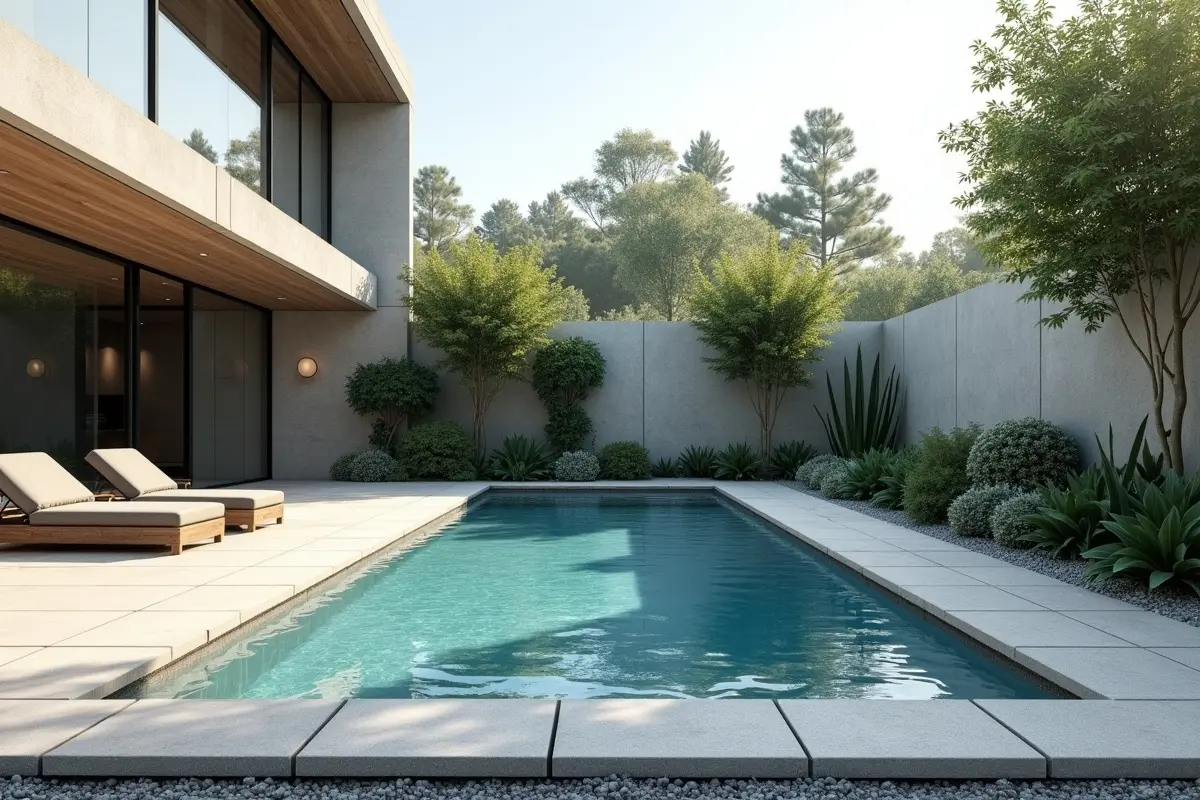
The maximalist pool, tiered waterfalls, fake boulders, built-in grottos, had its moment. What’s replaced it isn’t a trend so much as a correction. Across metropolitan areas, homeowners and designers are moving toward pools that look like they belong to the house rather than competing with it. Clean lines, dark interiors, uncluttered surrounds. Less theatre, more architecture.
Contents
The “Less is More” Logic Actually Holds Up
There’s a practical case for minimalism that goes beyond aesthetics. Simpler geometric shapes, rectangles, squares, long lap-style designs, create better water circulation than irregular organic forms. Better circulation means more even chemical distribution and fewer dead zones where algae take hold. Fewer decorative features means fewer surfaces to scrub, fewer mechanisms to service, and fewer points of failure over time.
When a pool has one finish instead of five, one surface instead of a mosaic of tiles and pebbled coves, the whole maintenance picture simplifies. That’s not a small thing when you’re looking at decades of ownership.
Color is Doing More Work Than People Realise
There’s a reason why modern pools are often designed with dark interior finishes such as charcoal, slate grey, or deep navy. Dark colors provide a mirror effect which reflects the sky, surrounding buildings, and trees on the water surface rather than having a flat, bright blue rectangle. This creates a pool that looks different during various times of the day and in different lighting conditions.
This kind of visual depth can be difficult to achieve with lighter colors, which is why dark interior finishes are so popular. In fact, the monochromatic color palette works so well over the entire outdoor area including grey paving, charcoal water, and white render on the house wall, as nothing clashes or distracts visually.
Submerged benches, concealed drainage, and slot drains help maintain a visually quiet pool surface while frameless glass fencing offers safety without interrupting the view with a traditional balustrade.
Small Lots Changed the Conversation
Block sizes in urban areas have contracted steadily over the last two decades, and pool design shifted with them. According to the Housing Industry Association (HIA), compact and plunge pool styles now represent a major segment of new installations in metropolitan areas, largely because smaller backyards have made full-size pools impractical for many homeowners.
That shift created an unexpected outcome: smaller pools often look more expensive than larger ones. A well-proportioned plunge pool with a limestone coping that matches the interior flooring, surrounded by large-format concrete pavers, reads as deliberate. A sprawling kidney-shaped pool shoehorned into the same space just reads as dated.
Minimalism works particularly well for constrained sites because it doesn’t try to deny the constraints, it works with them. A narrow rectangular pool along one boundary can visually widen the entire yard. The negative edge effect, where water appears to fall away at the horizon, adds perceived depth to sites that don’t have it naturally.
Execution is Where These Designs Succeed or Fail
The thing about minimalist pools is that there’s nowhere to hide. Decorative complexity can absorb small imperfections. A clean rectangle with a flush infinity edge and seamless coping cannot. Every surface is on display, and anything slightly off-level or poorly finished becomes the focal point by default.
That’s why the execution demands a higher level of precision than more ornate styles, not less. Achieving perfectly level infinity edges, flush waterline tiles, and coping that flows directly from interior pavers without transition strips or height changes requires careful planning from the start of the build. The pool builders sydney homeowners use for these projects are typically specialists in concrete construction, because concrete allows for the kind of custom formwork and fine-grade finishing that prefabricated shells can’t reliably deliver.
Smart automation also plays a role here. When the filtration system, lighting, and heating are controlled remotely and housed out of sight, the pool area stays uncluttered. LED perimeter lighting recessed below the waterline highlights the pool’s geometry without visible fixtures. The technology becomes part of the infrastructure rather than part of the look.
The Broader Shift This Reflects
What people are doing is they’re building outdoor spaces that are an extension of the interior space, not a separate zone that has its own theme, its own decorative language. When the same travertine that runs through the kitchen flows onto the pool coping, the barrier of outside and inside disappears. That’s what makes a 1,000-square-foot backyard feel right rather than small.
Minimalist pools aren’t easier to do or cheaper to do. They’re more demanding because everything has to be figured out before you break ground on any concrete. But once you get that figured out, that’s where you get a space that really does work visually, functionally, and in terms of property value for twenty or thirty years beyond the five or ten years it took to build what seems to be highly dated.